3/5/2011: UPDATED TO ADD VIDEOS, BELOW THE FOLD
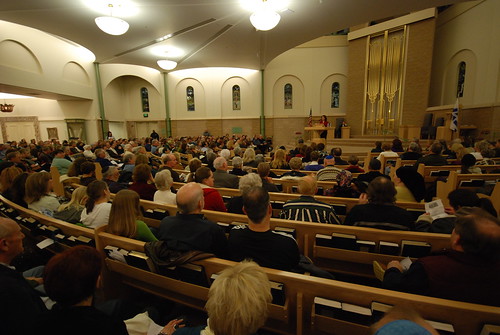
Americans Against Terrorism held an event last Thursday at the Hebrew Educational Alliance in Denver, with Mosab Hassan Yousef – the “Son of Hamas” – as the guest speaker.
For those unfamiliar with Mr. Yousef, he is the son of Hamas founder and leader Sheikh Hassan Yousef. He worked for ten years as an undercover informant for the Israeli Shin Beit, before converting to Christianity and seeking political asylum in the U.S.
As you might imagine, security at the event was tight.
Yousef spent about half of his talk recounting his bio: how he was recruited by the Shin Beit, his initial plans to be a “double-double-agent” spying on the Shin Beit itself on behalf of Hamas, and his gradual disillusionment with Hamas and the Palestinian leadership in general. He didn’t gloss over the fact that he had himself been tortured by the Israeli military after being arrested as a boy during the First Intifada, but later contrasted his torture (being beaten up by a couple of angry soldiers) with the torture he saw inflicted on other members of Hamas in prison by their own people (pins under the fingernails, burning, beatings, etc.). He also pointed out that his mistreatment was against Israeli policy, while the torture meted out by Hamas is their policy, and is less about extracting information from its victims than it is about creating a climate of fear and obedience on which the organization can base its power. It was the recognition of these differences which he credits with opening his eyes to the truth about Israel and Hamas alike.

The other half of his talk concerned the state of things in the Middle East and the prospects for reform within Islam. Regarding both he was surprisingly optimistic, despite giving several reasons not to be. In Yousef’s opinion, authoritarian regimes and terrorist movements in Islamic countries are only able to use Islam to hold power and sway the masses because the masses themselves do not understand their own religion – the Koran being written in an archaic dialect of Arabic quite different from the Arabic spoken on the street and vastly different from the local languages spoken in Islamic countries outside the Arab world. The situation he described somewhat resembled that of pre-Reformation Europe, where limited literacy and education and a Bible written and read from in Latin rather than the local tongues limited the understanding of Christianity by ordinary people.
Were Muslims to better understand their own religion, Yousef explained, including its flaws and contradictions, a reform movement would find fertile ground. To that end, he has been working with others to create new, authoritative vernacular translations of the Koran, with the English and modern Arabic versions already completed and published. He also envisions something almost unthinkable: a movie showing the life of Muhammad, including the rather unsavory episodes, which would aim to inform Muslims about all of their religion and cause them to reflect on what it means in a world fourteen centuries removed from its origins. Understanding their own religion on their own terms, he explained, would deprive authoritarian rulers and terrorist movements of much of the religion-based obedience that underlies their power. And Muslims might come to understand, as he did, that their real enemies are not Israelis, but the Muslim leaders who exploit and oppress their own people.

His optimism stems from the diffusion of the internet throughout the Muslim world. The Egyptian unrest, he said, may look somewhat like that in Iran in 1979, but below the surface it is very different — Egyptians today not only have the example of the Iranian Revolution to learn from (and, by implication, avoid repeating), but they also have better communications and information sources than the Iranians of 1979 and a nearly unstoppable means of organizing opposition. Even if the Muslim Brotherhood should somehow gain power, he predicted, its reign won’t last more than 12-18 months due to the same factors which brought down the Mubarak government. The gist of his message here was that radical Islam was a trend which had already passed an inflection point — its arc may still continue to a higher level of importance or power, but the trend has already crossed into decline.
Overall, a very interesting and informative event.
Videos: